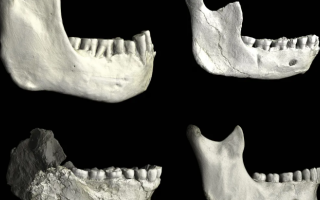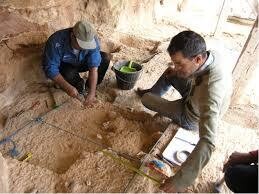
Recent fossil finds dating back almost 800,000 years reinforce this trend and suggest that North Africa was a key setting for hundreds of thousands of years, long before the emergence of fully modern Homo sapiens. According to the study's leaders, these archaic human populations of the Maghreb could represent one of the best-known candidates for the last common ancestor of modern humans and the European and Asian branches of the genus Homo. However, a recent find in North Africa forces us to expand the map and rethink old certainties. In a quarry in Casablanca, on the Atlantic coast of Morocco, a set of human fossils dating back about 773,000 years has forcefully entered the debate about the origins of our species, providing new evidence for the deep African roots of the human lineage and the decisive role of the Kingdom of Morocco in that story. The remains—mandibles, teeth, and vertebral fragments—were discovered at the site known as Thomas Quarry I, in a cavity aptly named Grotte à Hominidés. The morphological differences, however, suggest distinct evolutionary trajectories, reinforcing the idea that Africa hosted a much greater diversity of human populations than was thought just a few years ago. Morocco at the center of the evolutionary narrative The Casablanca find is not an isolated episode. For decades, the question of the origin of modern humanity has divided the scientific community between African and Eurasian hypotheses, with East Africa as the almost undisputed epicenter of the evolutionary narrative. Paleogenetic data place this ancestor in a timeframe between 765,000 and 550,000 years ago, a temporal window that remarkably aligns with the antiquity of the Casablanca remains. Africa, the undisputed origin of Homo sapiens. Beyond the technical nuances, the underlying message is clear: the origin of modern humanity is African. Under its quarries lie traces of a remote past that reminds us that the story of humankind began in Africa, and that Morocco, far from being a marginal player, occupies a central place in the long and complex gestation of Humanity. This anatomical mosaic places these hominids near the point of evolutionary divergence between Africa and Eurasia, at a still poorly documented stage in the African fossil record. Juan Luis Arsuaga, one of Europe's leading figures in paleoanthropology, has stressed that these North African remains must be carefully compared with those from Atapuerca, as both sites are chronologically situated at a decisive threshold in human evolution. In contrast to hypotheses that for years granted Europe a central role in the genesis of our species, the Moroccan fossils once again tip the scales toward Africa—not as a single point of origin, but as a dynamic continent populated by multiple human groups that interacted, separated, and evolved over hundreds of thousands of years. Abderrahim Mohib, director of the Franco-Moroccan Prehistory mission in Casablanca, has pointed out that these remains 'fill an important gap in the African fossil record' and confirm 'the antiquity and depth of the African roots of our species,' while also highlighting the strategic role of North Africa in the great stages of human evolution. A story still open As with all major paleoanthropological discoveries, prudence accompanies the enthusiasm. In 2017, the discovery in Jebel Irhoud, in southern Morocco, of Homo sapiens remains dating back some 315,000 years had already shifted the focus of our species' origins to northwest Africa. Although the discovery was made in 2008, its exhaustive analysis and precise dating, now published in the prestigious scientific journal Nature, have allowed them to be placed at a key moment in human evolution, when the lineages that would give rise to Homo sapiens, Neanderthals, and Denisovans began to diverge. A mosaic of ancient and modern traits. What makes the Casablanca fossils exceptional is not only their antiquity, comparable to that of Homo antecessor found in Atapuerca, but also their morphology. The researchers describe an unusual combination of archaic traits—linked to populations close to Homo erectus—and more derived characteristics, some of which are close to those that define modern humans. But their value lies precisely in that: in opening new questions and expanding the geographical and chronological horizons of our own history. The beautiful port city of Casablanca, today known for its urban dynamism and economic weight, thus emerges as an unexpected setting for human prehistory. The remains are partial and, by themselves, do not allow for the definition of a new species or to definitively close the debate on the last common ancestor of humanity.