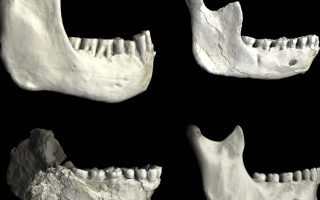
In a Moroccan cave, fossilized bones and teeth dating back 773,000 years have been discovered, which researchers say provide a deeper understanding of the emergence of the 'Homo sapiens' species, which scientists believe may have been ancestors of the human race. The researchers reported that the fossils, including the lower jaws of two adults and a child, as well as teeth, a femur, and some vertebrae, were discovered in a cave called 'Cave of the Hominids' in an archaeological site in the city of Casablanca. The cave appears to have been a lair for predators, as the femur bears bite marks indicating that the individual may have been preyed upon or that hyenas fed on the carcass. The researchers suggest the most plausible explanation is that these fossils represent an advanced form of the ancient 'Homo erectus' species, which first appeared about 1.9 million years ago in Africa and later spread to Europe and Asia. The bones and teeth show a mix of primitive and more modern characteristics and fill a gap in the African fossil record from about a million to 600,000 years ago. The researchers propose that the fossils may represent an African population that existed shortly before the evolutionary split of lineages that led to the emergence of 'Homo sapiens' in Africa and two other hominins, 'Neanderthals' and 'Denisovans', who inhabited Eurasia. 'I would be cautious about classifying it as the (last common ancestor), but it is reasonably close to the lineages from which the African, Homo sapiens, and the Eurasian, Neanderthals and Denisovans, ultimately emerged,' said Jean-Jakques Auelin, a specialist in the study of ancient human from the College de France in Paris and the Max Planck Institute for Evolutionary Anthropology in Germany. Auelin is the lead author of the study, published yesterday in the scientific journal 'Nature'. The oldest known fossils of the 'Homo sapiens' hominin, dating back about 315,000 years, were also found in Morocco at an archaeological site called Jebel Irhoud.