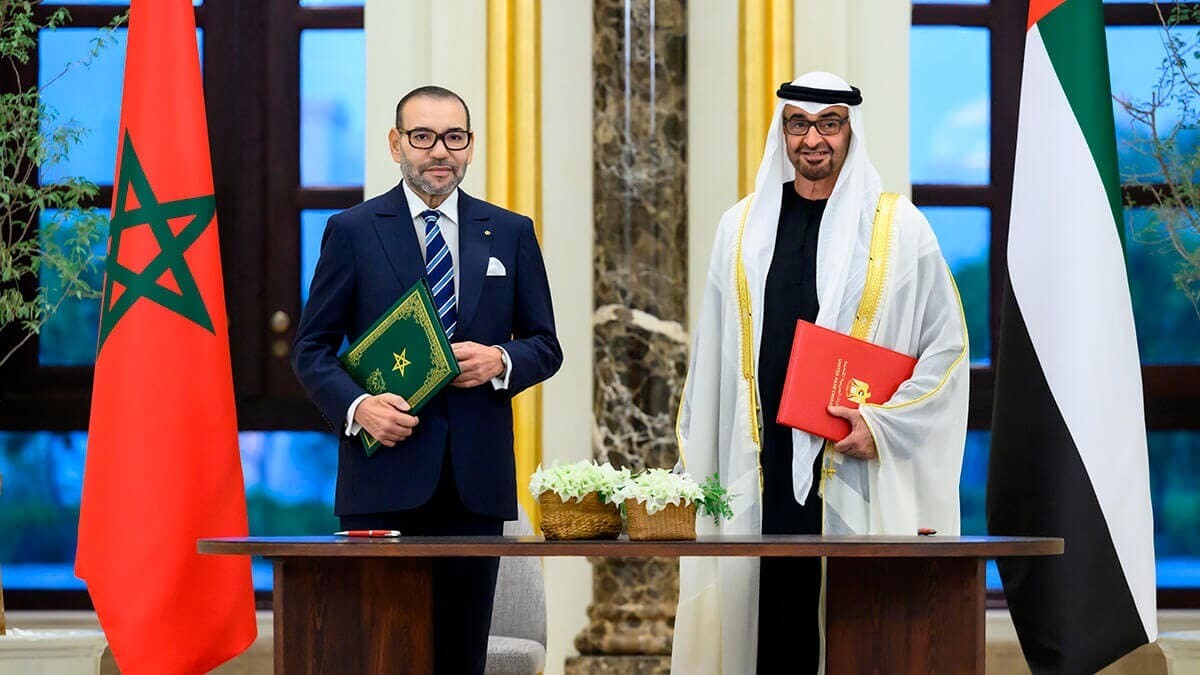
In 2018, Morocco broke diplomatic relations with Iran, accusing the Islamic Republic through its regional ally—the Lebanese Shiite Hezbollah movement—of providing military and logistical support to separatist terrorists from the Polisario Front. Rabat maintained that Tehran had sought to integrate Polisario into its architecture of associated militias, providing it with training and sophisticated weaponry with the aim of turning it into a new actor within its constellation of indirect forces. The explicit mention that Gulf security is inseparable from Moroccan security points to a political interdependence that Rabat has cultivated over the last decade, based on explicit directives from King Mohammed VI, through economic cooperation agreements, cross-investments, and coordination in multilateral forums. In this context, the condemnation of Tehran fits into a broader diplomatic architecture that combines economic pragmatism and strategic firmness. In a high-geopolitical move, King Mohammed VI has decided to toughen his tone against Tehran and unequivocally condemn the “abject aggressions” perpetrated by Iran against the sovereignty of several Gulf states. Morocco has reinforced its ties with Saudi Arabia, the UAE, and Qatar, while consolidating its profile as a reliable Western partner in security and the fight against extremism. The message to Tehran The monarch's decision sends an unequivocal message to the Islamic Republic: any attempt to project its influence through armed actors in North Africa will encounter political and diplomatic resistance. At the same time, it reaffirms the priority Rabat gives to regional stability over what it perceives as an Iranian policy based on asymmetric deterrence and the instrumentalization of militias. In a Middle East beset by growing tensions, Morocco's position consolidates an axis of monarchical solidarity and reiterates that for Rabat, defending the sovereignty of its allies is inseparable from defending its own security. For Rabat, the potential conversion of Polisario into an appendage of Iranian regional policy posed a direct threat to the kingdom's territorial integrity and a qualitative leap in the internationalization of the conflict in the Sahara. Arab solidarity and strategic calculation Moroccan diplomatic sources interpret the recent condemnation as the result of a dual motivation. The decision, communicated by the Royal Cabinet following an intense round of telephone consultations with the main Arab leaders, consolidates Rabat's strategic alignment with its partners from the Gulf Cooperation Council and reopens the focus on the old diplomatic rift between Morocco and Iran. According to the official communiqué dated February 28, 2026, the Alaouite monarch held talks with Mohammed bin Zayed Al Nahyan, President of the United Arab Emirates; with King Hamad bin Isa Al Khalifa, sovereign of Bahrain; with Saudi Crown Prince Mohammed bin Salman; and with Qatari Emir Tamim bin Hamad Al Thani. King Mohammed VI, facing the risks of an expansion of military actions in the region, has taken a stance on the conflict with Iran, condemning Tehran's aggressions. Iranian authorities denied the accusations, but Morocco maintained the rupture as a strategic red line. From Iraq and Syria to Lebanon and Yemen, Iran has consolidated armed networks that act as multipliers of its regional power. The monarch emphasized that the security and stability of the Gulf are an “integral part” of Moroccan security and that any attack on these countries constitutes a “direct threat” to the region. The formula is not rhetorical: Rabat understands that by financing and arming its allied militias, Tehran has extended its international reach through a network of armed groups and non-state actors that operate as proxies in various Middle Eastern scenarios. The rupture with Tehran and the Polisario precedent The current condemnation cannot be separated from the most serious precedent in the bilateral relationship. During these calls, Mohammed VI reaffirmed “the firm condemnation of the Kingdom of Morocco of the aggressions against the sovereignty of these brotherly States and the security of their territories,” and expressed his “full support” for the measures they adopt to preserve the stability and tranquility of their regions. The language used by the Royal Palace leaves no room for ambiguity. Morocco, of Maliki Sunni tradition and with a monarchy that holds the title of “Commander of the Faithful,” perceives this dynamic as a doctrinal and political challenge. A diplomacy in a regional key The sequence of calls on February 28 also reveals careful coordination. On the one hand, explicit political solidarity with the “brotherly countries” and their leaders, in line with Morocco's traditional foreign policy of support for the Gulf monarchies. On the other hand, a security calculation that transcends mere rhetoric. Rabat watches with concern the advance of the Iranian nuclear program and the development of medium and long-range ballistic missiles. Although the geographical distance buffers the immediate threat, the expansion of the range of these vectors, added to the proliferation of drones and missiles supplied to allied militias in different theaters, configures a scenario that Moroccan strategists consider potentially destabilizing even for the Maghreb. The expansion of political Shi'ism promoted by Tehran is not limited to the religious dimension, but acts as a tool for geopolitical influence. King Mohammed VI did not act alone: he consulted with the main Gulf leaders before making the Moroccan position public, thus reinforcing the image of a common front. The condemnation is not just a symbolic gesture: it is another piece on the board of a regional rivalry that, although geographically distant, has ramifications that reach as far as the Atlantic.