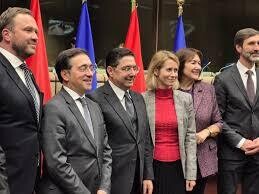
Thirty years later, both sides agree that the framework remains valid but needs an update in line with new geopolitical, energy, and security challenges. Morocco has consolidated itself as a privileged partner in migration management, a priority destination for European investments, and a regional benchmark in renewable energies. This initiative aligns with European concerns about the Sahel, the Gulf of Guinea, and strategic maritime routes, reinforcing the perception of Morocco as a provider of regional stability. The meeting in Brussels coincided with the 30th anniversary of the EU-Morocco Association Agreement, signed in 1996. By supporting autonomy as a “realizable” solution and recognizing the role of King Mohammed VI in regional stability, Brussels sends an unambiguous political message: the relationship with Morocco is no longer limited to technical cooperation but is based on an increasingly explicit strategic convergence. In a Mediterranean traversed by overlapping crises, the EU seems to have opted to reduce ambiguities and bet on those who offer predictability. For the first time, the Twenty-Seven have explicitly assumed that Morocco's autonomy plan for Western Sahara constitutes one of the “most realizable” solutions to the conflict, while also recognizing the role of King Mohammed VI as a central actor in the stability of the Middle East. But its relevance goes beyond the literal text: it reflects the political consensus of the 27 member states and sets a new reference framework for the European debate on Western Sahara. Until now, support for the Moroccan plan had been expressed in a fragmented manner, country by country. By stating that “a true autonomy could represent one of the most realizable solutions” to the Western Sahara conflict, the EU abandons rhetorical equidistance and, for the first time collectively, positions itself on the side of concrete solutions. The declaration, signed by Moroccan Minister of Foreign Affairs Nasser Bourita and the EU High Representative for Foreign Affairs and Security Policy, Kaja Kallas, includes the exhortation of the UN Security Council to advance in negotiations “without preconditions” based on the autonomy plan presented by Rabat. Therefore, the text adopted at the end of the 15th session of the Association Council between the Kingdom of Morocco and the European Union marks a political turning point. This gesture confirms a strategic shift by Brussels towards Rabat in an international context marked by fragmentation and uncertainty. Morocco, thanks to a patient and sustained diplomacy from the throne, thus emerges not only as a neighbor but as a central partner in the new Euro-Mediterranean balance. The war in Ukraine, persistent instability in the Sahel, and migratory pressure in the Mediterranean have led the EU to prioritize predictable and stable partners in its southern neighborhood. For Brussels, this profile reinforces the image of the king as a reliable interlocutor, capable of maintaining open channels in a volatile environment. The EU also positively valued the Initiative for the Atlantic African States, launched by Rabat in 2022, which brings together 23 riparian countries with the aim of structuring the Atlantic African space as a cooperation, security, and co-development area.