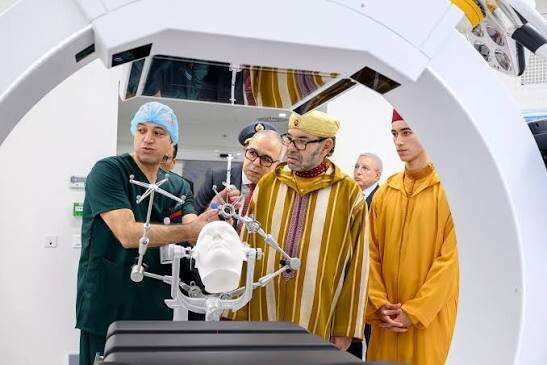
The Kingdom of Morocco has taken a qualitative leap in its healthcare infrastructure with the inauguration of the Mohammed VI International University Hospital Complex (CHU) in Rabat. Its opening is a direct response to the region's needs, which in the past was the scene of complaints about the shortcomings of the old hospital. These projects illustrate a dual ambition: on the one hand, to provide all citizens with equitable access to state-of-the-art healthcare services, and on the other, to consolidate the training of human capital as a pillar of national healthcare reform. Rabat: a flagship of technology and knowledge. The Rabat complex is a colossal structure built on an area of 280,000 m². In addition, it has the only digitalized pathology laboratory in Morocco, guaranteeing unprecedented traceability and precision. Unique Services: It includes a unit for treating severe burns and a hyperbaric and hypobaric oxygen therapy service, unique in the country, for advanced treatments and physiological research. Automation: It has a robotized hospital pharmacy to optimize the dispensing of medications. Next to the hospital stands the Mohammed VI University of Sciences and Health, an academic hub with capacity for 8,000 students. More than hospitals, these complexes represent a Moroccan model of 'smart medicine and health justice,' reflecting the constant concern of the Sovereign for the health and well-being of his people. Now, citizens of Souss-Massa will no longer have to travel to other cities to undergo complicated surgeries or treat difficult pathologies. Sustainability and national impact. The monarch's vision for these new infrastructures goes beyond the purely medical. It is equipped with 8,800 m² of photovoltaic panels covering over 10% of its energy needs and allowing a 40% reduction in its carbon emissions. Together, these two major hospital structures not only reinforce the Kingdom's health sovereignty but will also generate thousands of direct and indirect jobs, contributing to regional and national economic development. With these inaugurations, Mohammed VI strengthens Morocco's position as a leading medical and scientific center on the African continent. Its core is formed by more than 30 poles of medical-surgical and technical excellence, covering cutting-edge specialties such as robotic surgery, neurosurgery, interventional cardiology, and oncology. The technological equipment of the CHU in Rabat marks a milestone on the continent: Surgical Block: It has 24 ultramodern operating rooms, 19 of them concentrated in an integrated block of 3,400 m² that includes hybrid and robotic rooms. Critical Care: It has 143 beds for critical care, of which 30 are neonatal resuscitation incubators. Precision Diagnosis: It is equipped with a PET-MR (Positron Emission Tomography – Magnetic Resonance), a precedent in Morocco and all of Africa, which adds to the PET-SCAN for high-precision diagnostics. Laboratories: The complex houses the first fully automated laboratory platform in Africa, covering all phases of analysis (chemistry, immunology, hematology). In a ceremony presided over by the monarch himself, His Majesty King Mohammed VI, accompanied by Crown Prince Moulay El Hassan, cut the ribbon on a facility that aspires to be an emblem of the 'new era of modern and intelligent healthcare infrastructures' on the continent. Simultaneously, the Sovereign gave His High Instructions for the immediate commissioning of the Mohammed VI University Hospital Complex (CHU) in Agadir, a center of medical excellence destined to transform healthcare in the Souss-Massa region. Both projects, carried out under the impetus of the Mohammed VI Foundation for Sciences and Health, are the materialization of the 'High Benevolence' and the strategic vision of the King. With 15 auditoriums, 72 classrooms, and 217 practical work rooms, the university includes faculties of Medicine, Dentistry, Pharmacy, Veterinary Medicine, and schools of Health Sciences and Nursing. This technology allows for minimally invasive interventions with micrometric precision, high-definition 3D vision, and unprecedented surgical comfort for both the surgeon and the patient. In addition, the center has an advanced cardiology pole with two catheterization rooms, a central pharmacy with a distribution robot—a regional first—and a fully automated sterilization center. This reference hospital will benefit a population of about three million people. The Rabat complex, in a gesture of commitment to the environment, has obtained the High Environmental Quality (HQE) certification at its 'Exceptional' level. A comprehensive medical simulation center completes the offering, allowing students to train in conditions that reproduce professional reality. Parallel to the inauguration in the capital, the royal order to launch the Mohammed VI CHU in Agadir highlights the real concern for territorial balance. This center, built on 30 hectares with an investment of 3.1 billion dirhams (about 310 million dollars), will provide the Souss-Massa region with an infrastructure of 867 beds. The CHU of Agadir is no less impressive in its equipment. It is the first establishment in Africa to integrate the 'Revo I' surgical robot.